
How to Fix Uneven Material Discharge in Linear Vibrating Screens
In modern industrial production, linear vibrating screens, with their advantages of large processing capacity, simple structure, and convenient maintenance, have become core equipment for material classification and screening in industries such as mining, metallurgy, coal, and chemicals. However, in actual operation, many production sites often encounter a thorny problem—uneven material discharge from the screen surface, even exhibiting biased flow.
This phenomenon not only directly reduces screening efficiency and causes impurities in the finished material, affecting downstream processes, but also causes potential damage to the equipment itself, such as excessive wear of the screen mesh and uneven load on the vibrating motor, ultimately shortening the service life of the vibrating screen. To help companies fundamentally solve this problem, this article will comprehensively analyze the underlying causes of uneven material discharge from linear vibrating screens and provide systematic and operable optimization solutions.
How to Fix Uneven Material Discharge in Linear Vibrating Screens
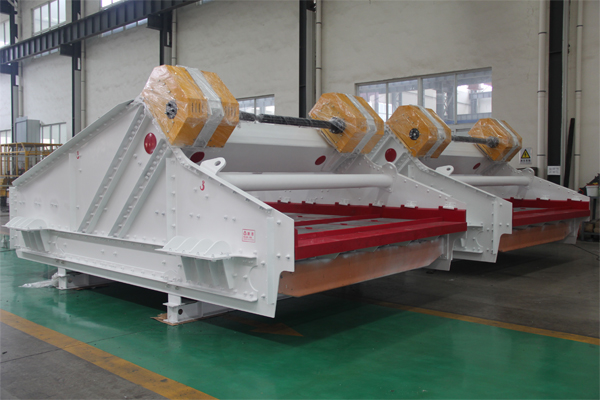
I. Root Cause Analysis: Why Does Uneven Material Discharge Occur in Linear Vibrating Screens?
To solve the problem of uneven material discharge, it is essential to understand the working principle of linear vibrating screens. Linear screens typically use two identical vibrating motors rotating synchronously in opposite directions. The excitation forces generated by the eccentric blocks cancel each other out in the direction parallel to the motor shaft, but superimpose in the perpendicular direction, causing the screen body to reciprocate along a linear trajectory.
When the material on the screen surface no longer exhibits a uniform “linear jumping” motion, but instead shifts to one side or accumulates, it is usually due to the following four factors:
Feeding Stage Offset: The feeding stage is the first step for material to enter the screen. If the feeder is not installed in an accurate position or the material drop point of the belt conveyor is not aligned with the center of the screen surface, the material will shift laterally upon entering the screen. Initial velocity deviation and uneven accumulation of the center of gravity often directly lead to one-sided accumulation of material on the screen surface, resulting in uneven discharge.
Inconsistent Excitation Force Vectors: The core power of a linear screen comes from two vibrating motors. If there is a difference in the weight of the eccentric blocks, inaccurate angle adjustment, or motor aging causing power output deviation, the center of gravity of the screen box will experience uneven force, resulting in torsional swaying or non-ideal linear motion, further causing material deviation.
Equipment Foundation and Levelness Errors: Vibrating screens have extremely high requirements for the flatness of the installation foundation. After long-term operation, foundation settlement or inconsistent stiffness of the support springs can cause slight tilting of the screen box. Material, under gravity, accumulates at the lowest point, resulting in uneven discharge.
Structural Stiffness and Screen Tension Issues: If cracks appear at the welded joints of the screen box frame, or bolts loosen, local stiffness decreases, altering the vibration frequency and causing secondary vibrations. Uneven screen tension creates localized unevenness, causing material to accumulate in the “grooves,” ultimately leading to abnormal discharge distribution.
II. Systematic Solutions: Practical Steps to Repair Uneven Discharge
For the above four types of problems, enterprises can achieve precise calibration through layered troubleshooting and repair from external feeding to internal power.
1. Optimize the Feeding System, Control the “Source”
The distribution of material on the screen surface largely depends on its entry method.
Install a distributor: Install a funnel-shaped distributor or receiving hopper above the feed inlet. This physical buffer will evenly distribute the material, ensuring coverage of the entire screen width and reducing initial flow deviation.
Adjust the drop point: The guide liner needs precise adjustment to ensure the material falls vertically and aligns with the screen’s centerline, eliminating lateral initial velocity deviation.
Control the feed rate: Ensure the feed rate matches the screen load to avoid excessive material accumulation, which can cause localized blockages or slippage.
2. Precision Calibration of the Power System: The synchronization of the vibrating motor and the consistency of the eccentric block angle are crucial for the accuracy of linear motion.
Check the eccentric block angle: After stopping the machine, confirm that the included angle of the eccentric blocks of both motors is completely consistent. Even a 5° difference can cause material flow deviation.
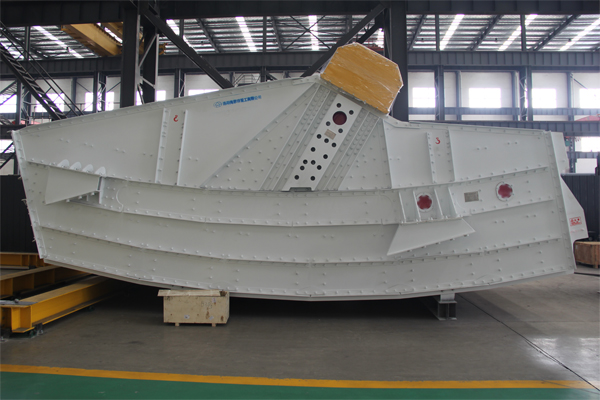
Synchronization test: Ensure the motor electrical circuit is complete and starts synchronously. A vibration tester can be used to measure the amplitude at the four corners of the screen box. If the difference exceeds 0.5mm, readjustment is necessary.
1. Motor Maintenance
Regularly check the wear of motor bearings and brushes to prevent abnormal screen movement caused by power output fluctuations.
2. Balance the Support System and Eliminate Tilt
Replace Matching Springs
Vibrating screen springs must be replaced in pairs to avoid stiffness differences due to metal fatigue and ensure stable screen vibration.
Precise Level Calibration
Use a level to measure the horizontal and vertical levelness of the screen box. Fine adjustments can be made using spring base shims to control the horizontal error within 2mm.
3. Refined Screen Surface Maintenance
Screen Tensioning
Utilize the hook tensioning system to ensure the screen is flat and evenly stressed, reducing localized material accumulation.
Structural Integrity Check
Regularly check the welds and bolt fixation of the crossbeams and longitudinal beams to prevent secondary vibrations caused by localized stiffness reduction.
Screen Surface Cleaning
Accumulated material and deposits can alter the material flow trajectory. Regularly cleaning the screen surface and the material accumulation tray below helps maintain uniform discharge.
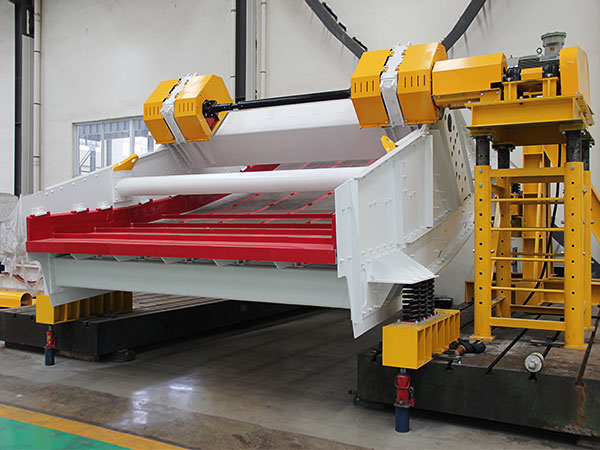
III. Prevention First: Establishing a Standardized Operation and Maintenance System
Continuous and systematic maintenance management can significantly reduce the probability of uneven material output.
Institutionalized Inspection: Observe the material flow trajectory on the screen surface every shift. Under normal conditions, the material should be flat, of uniform thickness, and without significant accumulation.
Monitoring Material Characteristics: When moisture, viscosity, or particle size distribution changes, the angle and amplitude of the vibrating motor’s eccentric block should be adjusted promptly to adapt to the new operating conditions.
Digital Upgrade: Install vibration monitoring systems in key processes. Sensors collect amplitude, frequency, and tilt angle data in real time, providing early warning of flow deviation trends and reducing downtime and accident risks.
Summary:
Solving the problem of uneven material output from linear vibrating screens requires addressing four dimensions: uniform feeding, symmetrical power, stable foundation, and structural integrity. Combining meticulous calibration with scientific maintenance is essential to maximizing screening efficiency.
Through systematic management and optimization, not only can the precision of finished materials be significantly improved and impurities reduced, but the lifespan of vibrating screens and meshes can also be extended, reducing unplanned downtime and thus achieving higher economic benefits in the fiercely competitive raw material processing market.
If complex vibration instability or flow deviation problems are encountered during the calibration process, it is recommended to contact a professional vibration equipment team to obtain a customized screening system optimization solution, fundamentally improving the stability and capacity performance of the production line.