
Noise Reduction Methods for Industrial Linear Vibrating Screens: Engineering Analysis and Structural Optimization
In industrial material processing systems, the linear vibrating screen remains one of the most widely applied screening solutions due to its high throughput, stable linear motion trajectory, and adaptability to bulk materials.
However, noise emission during operation is not merely a comfort issue—it is closely related to mechanical balance, structural integrity, and long-term operational stability.
In high-capacity mining, aggregate, coal, and chemical processing plants, operational noise levels of vibrating screens may reach 75–95 dB, depending on excitation force, feed characteristics, and installation conditions. Sustainable equipment design therefore requires systematic noise control based on vibration engineering principles.
Noise Reduction Methods for Industrial Linear Vibrating Screens
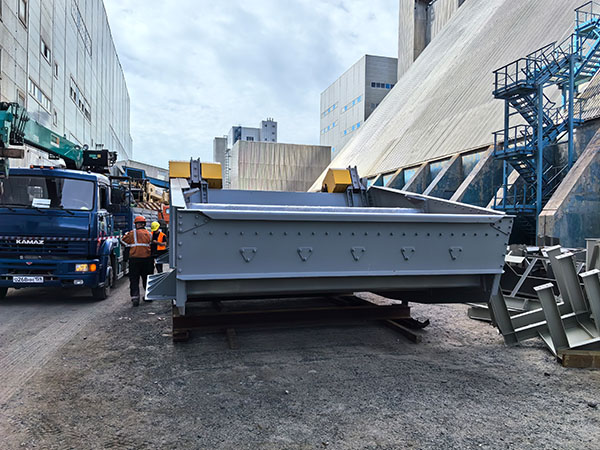
This article examines industrial linear vibrating screen noise from a structural and dynamic perspective and outlines advanced noise reduction strategies grounded in mechanical engineering.
1. Understanding the Source of Noise: A Vibration Engineering Perspective
Noise in a linear vibrating screen is not generated randomly. It typically originates from four core mechanisms:
1.1 Mechanical Vibration Radiation
The vibration motors generate excitation force through eccentric blocks, producing periodic linear motion. This oscillatory force is transmitted to the screen body and radiated as airborne noise.
1.2 Structural Resonance
If the excitation frequency approaches the natural frequency of the screen frame or supporting structure, resonance amplification occurs, significantly increasing noise intensity.
1.3 Material Impact and Friction
Bulk material striking the screen deck generates impact noise, especially when processing coarse aggregates or high-density ore.
1.4 Mechanical Wear and Clearance
Loose bolts, worn bearings, and frame fatigue introduce secondary vibration, resulting in abnormal acoustic emissions.
Effective noise reduction must therefore address both dynamic excitation and structural response.
2. Excitation Force Optimization and Dynamic Balancing
One of the most overlooked causes of excessive noise is improper excitation configuration.
Engineering Recommendations:
Select vibration motors with precise dynamic balancing calibration
Adjust eccentric block angles to optimize excitation force
Avoid excessive amplitude beyond screening requirements
Match motor power to material load rather than oversizing
A properly tuned excitation system reduces unnecessary kinetic energy transfer and limits vibrational radiation.
Advanced manufacturers often perform dynamic simulation testing to ensure the working frequency avoids structural resonance zones.
3. Structural Stiffness and Finite Element Optimization
Frame design plays a decisive role in acoustic performance.
In traditional designs, insufficient side plate stiffness or uneven stress distribution leads to micro-deformation, which amplifies vibration.
Advanced Design Measures:
Use finite element analysis (FEA) to simulate stress concentration
Optimize rib reinforcement layout
Employ high-strength, low-alloy steel for improved rigidity
Design symmetrical force distribution structures
Increasing structural stiffness raises the natural frequency of the frame and prevents resonance within the operational range.
This engineering approach significantly lowers radiated sound pressure levels.
4. Vibration Isolation and Energy Dissipation Systems
Isolation is critical to preventing vibration transmission to foundations and surrounding structures.
Professional Isolation Solutions:
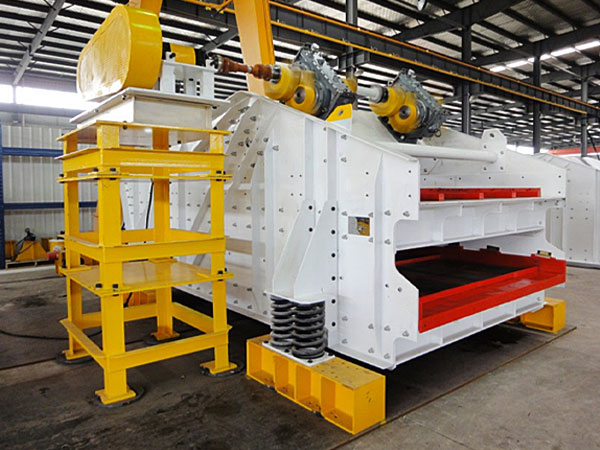
Replace steel springs with rubber composite or polyurethane springs
Install elastomer vibration isolators between screen body and support frame
Apply damping coatings to high-vibration zones
Integrate anti-vibration base plates
These components convert mechanical vibration energy into thermal energy, reducing acoustic propagation.
Isolation efficiency directly influences overall plant noise levels.
5. Material Flow Control and Impact Mitigation
Material impact noise is particularly significant in mining and aggregate industries.
Engineering improvements include:
Installing feed buffer chutes
Using rubber-lined impact zones
Optimizing feed height and drop angle
Controlling feed rate to prevent overload
Replacing traditional woven steel mesh with polyurethane panels can reduce collision noise by up to 5–8 dB in certain applications.
6. Bearing and Mechanical Component Management
Bearings are critical rotating components and common noise amplifiers when worn.
Technical management includes:
Using high-precision heavy-duty bearings
Implementing scheduled lubrication systems
Monitoring temperature and vibration spectrum
Conducting periodic dynamic testing
Condition-based maintenance (CBM) significantly reduces abnormal acoustic spikes caused by mechanical degradation.
7. Acoustic Enclosure Engineering for High-Standard Facilities
In facilities subject to strict environmental regulations, structural noise reduction may be supplemented by acoustic containment systems.
Options include:
Modular soundproof enclosures
Multi-layer sound-absorbing panels
Industrial-grade acoustic insulation curtains
Partial containment chambers with ventilation integration
While enclosure systems do not eliminate vibration sources, they effectively reduce airborne noise exposure.
8. Long-Term Benefits of Engineering-Level Noise Reduction
Adopting systematic noise control measures provides measurable operational benefits:
Reduced mechanical fatigue
Extended structural lifespan
Improved operator safety compliance
Lower maintenance frequency
Enhanced equipment reliability
From an engineering standpoint, lower noise levels typically indicate better dynamic balance and structural optimization.
Conclusion
Noise in industrial linear vibrating screens is fundamentally a structural dynamics issue rather than a simple byproduct of vibration. Effective control requires coordinated optimization of excitation force, structural stiffness, vibration isolation, and material handling design.
By applying mechanical analysis and modern engineering techniques, manufacturers can significantly reduce operational sound pressure while improving screening efficiency and long-term reliability.
For high-capacity production lines operating under demanding industrial conditions, selecting a technically optimized linear vibrating screen is not only a matter of environmental compliance—but also a strategic investment in equipment performance and operational sustainability.